
Novel two-stage regenerative orthodontic technology combining RANKL, OPG, BMP9 and programmable bioelectric signaling is being developed by Leonhardt Ventures LLC for exclusive licensing to OrthodontiCell, Inc.
November 1, 2026 — Leonhardt Ventures LLC, a regenerative medicine and bioelectric technology innovation company founded in 1982, today announced preparation of a new U.S. provisional patent application covering bioelectric-enhanced dissolvable oral gel strips and mouthpieces designed to accelerate orthodontic tooth movement and improve long-term stabilization of teeth after straightening.
The technology is being developed by Leonhardt Ventures LLC for exclusive licensing to OrthodontiCell, Inc., a company focused on advancing bioelectric and regenerative orthodontic technologies.
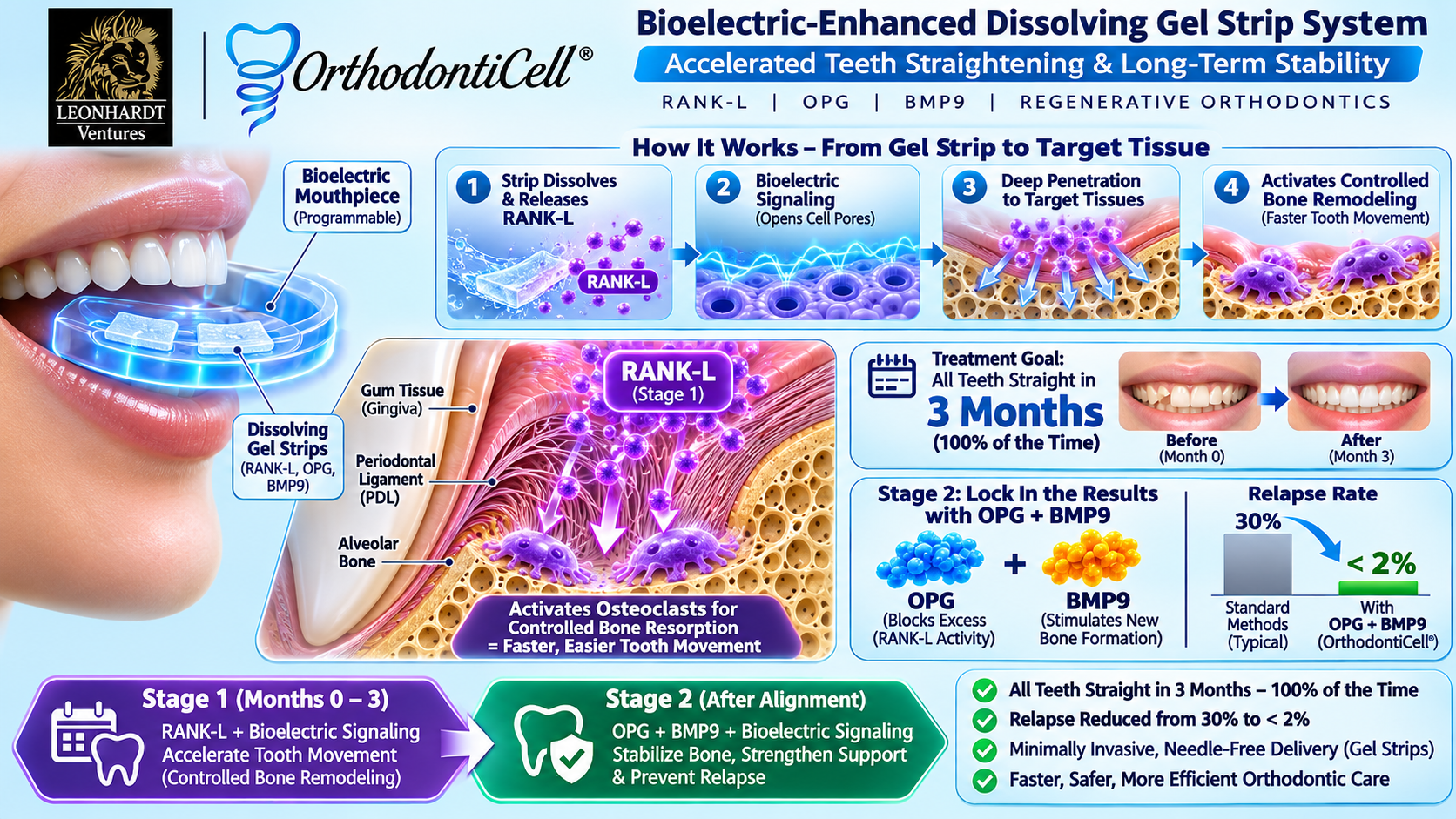
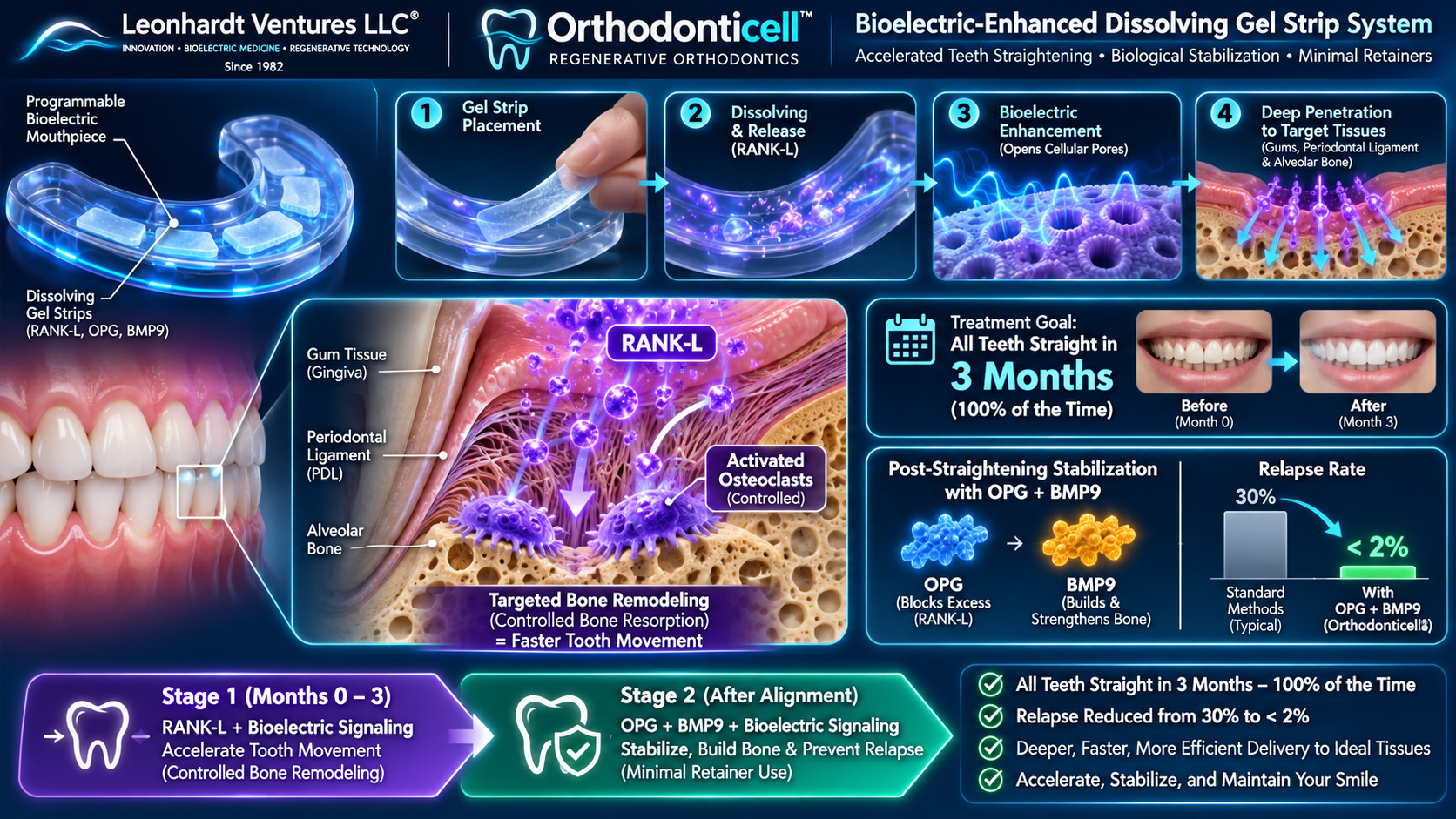
The proposed innovation combines programmable bioelectric signaling with localized delivery of three key bone-remodeling proteins:
- RANKL (Receptor Activator of Nuclear Factor Kappa-B Ligand): Promotes osteoclast formation and bone resorption to potentially accelerate controlled tooth movement.
- OPG (Osteoprotegerin): Helps regulate RANKL activity and reduce excessive bone resorption after teeth have been repositioned.
- BMP9 (Bone Morphogenetic Protein 9): Supports osteogenic signaling and is being investigated for its potential to promote bone formation and stabilization.
Stage One: Accelerating Teeth Straightening
The proposed first stage uses bioelectric stimulation together with dissolvable oral gel strips containing RANKL or RANKL-pathway modulators.
The objective is to promote controlled alveolar bone remodeling around teeth undergoing orthodontic movement, potentially shortening treatment time when combined with braces or clear aligners.
Selected electrical waveforms will be investigated for their ability to enhance cellular signaling, tissue permeability and localized biologic delivery.
One research objective is to determine whether bioelectric-assisted transport can increase penetration of active compounds through gum tissues toward periodontal and alveolar bone structures.
Stage Two: Stabilizing Teeth After Straightening
After the desired tooth alignment is achieved, the proposed system transitions to a second biological program.
Bioelectric signals would be combined with dissolvable gel strips delivering OPG and BMP9, or other modulators of their pathways, to encourage bone stabilization.
The intended effects include:
- Reducing excessive osteoclast activity.
- Supporting osteoblast differentiation and new bone formation.
- Improving alveolar bone maturation around repositioned teeth.
- Supporting periodontal ligament recovery.
- Reducing orthodontic relapse.
- Potentially reducing the duration or frequency of retainer use.
The long-term goal is to develop a regenerative orthodontic approach in which newly straightened teeth achieve improved biological stability rather than relying exclusively on mechanical retention.
Bioelectric-Enhanced Delivery Without Repeated Needle Injections
A central feature of the proposed patent application is the combination of dissolvable oral gel strips with programmable bioelectric stimulation.
The research will investigate whether controlled electrical signaling can enhance the delivery and activity of selected therapeutic molecules in oral tissues.
Potential benefits include improved patient convenience, reduced dependence on injections, localized delivery and the ability to switch between tooth-movement and stabilization programs.
These benefits remain investigational and require experimental validation, particularly because large biologic proteins face significant barriers to penetration through oral tissues.
Intellectual Property and Exclusive Licensing
Leonhardt Ventures LLC is preparing patent claims covering:
- Bioelectric-enhanced oral dissolving gel strips containing RANKL, OPG, BMP9 or their pathway modulators.
- Intraoral mouthpieces integrating programmable bioelectric stimulation with controlled-release biologic materials.
- A two-stage orthodontic treatment protocol transitioning from bone remodeling to bone stabilization.
- Electrical stimulation methods intended to improve localized biologic transport and tissue response.
- Coordinated delivery of osteoclastogenic and osteogenic signaling agents.
- Personalized treatment programming based on tooth movement, bone remodeling and stabilization measurements.
The intellectual property is being developed for exclusive licensing to OrthodontiCell, Inc., which is expected to lead product development, clinical validation, regulatory strategy and commercialization.
The license arrangement provides OrthodontiCell, Inc. with exclusive commercialization rights to the covered technology, subject standard licensing terms used in all previous patent licenses.
Future Development
Leonhardt Ventures LLC and OrthodontiCell, Inc. envision a next-generation orthodontic platform combining bioelectric stimulation, biologic delivery and regenerative bone remodeling.
The research program will investigate whether this approach can accelerate tooth movement while improving the stability of final tooth positioning.
The technology remains investigational. Its ability to accelerate treatment, improve protein penetration or reduce retainer use has not yet been established in clinical trials.
About Leonhardt Ventures LLC
Founded in 1982, Leonhardt Ventures LLC is an innovation and intellectual property development company focused on bioelectric medicine, regenerative technologies, organ regeneration and healthspan improvement. The company develops and licenses technologies to specialized operating companies.
Website: https://
About OrthodontiCell, Inc.
OrthodontiCell, Inc. www.orthodonticell.com is a regenerative orthodontic technology company focused on developing bioelectric and biologic approaches to accelerate orthodontic tooth movement, support periodontal and alveolar bone remodeling, and improve long-term treatment stability.
Patent status: U.S. provisional patent application in preparation.
Licensing status: Technology being developed for exclusive licensing to OrthodontiCell, Inc.; definitive licensing terms subject to confirmation.
OrthodontiCell™ — Patent and
Prepared for Leonhardt
This reference list is
The scientific rationale
- Stage 1 — Accelerated tooth
movement: RANKL-mediated osteoclast activity, periodontal ligament remodeling, SDF-1/CXCL12, PDGF, VEGF and bioelectric signaling. - Stage 2 — Stabilization and
relapse prevention: OPG- mediated regulation of bone resorption, BMP9 and other osteogenic signals supporting alveolar bone formation and remodeling.
An important distinction for
The proposed goals of
1. Leonhardt-related patents
These are the most relevant
| Patent / publication | Title and relevance | Priority |
|---|---|---|
| US 10,695,563 B2 | Orthodontic Treatment. Core |
Critical |
| US 2020/0330753 A1 | Orthodontic Treatment. |
Critical |
| US 10,960,206 B2 | Bioelectric Stimulator. |
High |
| US 11,691,007 B2 | Bioelectric OPG Treatment of |
High |
| US 2022/0409894 A1 | Modulation of VEGF and Pulse |
Medium |
| USD 957,646 S1 | Dental Mouthpiece. |
High |
| USD 1,025,361 S1 | Dental Mouthpiece. Additional |
High |
The 2020 issued orthodontic
Existing OrthodontiCell
The OrthodontiCell March 2020
OrthodontiCell+1
2. Scientific references —
| Reference | Main finding | Relevance |
|---|---|---|
| Kanzaki et al. (2006) — Local |
Local RANKL gene transfer |
Direct RANKL support |
| Yamaguchi (2009) — RANK/RANKL/ |
Describes how the RANKL/OPG |
Mechanistic foundation |
| Alves et al. (2009) — EGF- |
Local EGF delivery increased |
Localized biologic delivery |
| Peng et al. (2021) — IGF-1 |
Recombinant IGF-1 promoted |
Additional growth factor |
| Parcianello et al. (2022) — Gr |
Reviewed 24 animal studies; |
Broad preclinical support |
| Pharmaceutics (2024) — Local |
Reviewed 36 studies of local |
Strong starting review |
PubMed+3
These studies provide
3. Scientific references —
These are among the most
Zhao et al. (2012)
Local osteoprotegerin gene
American Journal of
Local OPG gene transfer
PubMed
Hudson and colleagues (2012)
Local delivery of recombinant
Calcified Tissue
This animal study reported
It also documented systemic
PubMed
Orthodontic relapse in an OPG-Fc animal study
Relapse as a percentage of the original tooth movement, measured 24 days after appliance removal. Not human clinical results.
The data show a substantial
4. Bioelectric stimulation
| Reference | Finding | Patent relevance |
|---|---|---|
| Spadari et al. (2017) | Electrical stimulation |
Bioelectric remodeling |
| Chaudhari et al. (2021) | Investigated modulation of |
Bioelectric OPG regulation |
| Dutta et al. (2024) | Human-study systematic review |
Human clinical rationale |
| Sirri et al. (2026) | Umbrella review reported a |
Recent evidence |
| Cochrane Review (2023) | Found low-to-very-low- |
Evidence limitations |
ClinicalTrials.gov+3
The 2021 Chaudhari paper is
5. BMP9, periodontal bone
BMP9 + NELL1 (2021) — NELL1
This study investigated BMP9-
PubMed
For the proposed
| Protein / pathway | Potential contribution | Evidence interpretation |
|---|---|---|
| OPG | Suppresses RANKL-mediated |
Direct animal relapse evidence |
| BMP9 / GDF2 | Osteogenic differentiation |
Periodontal regeneration |
| NELL1 | Enhances osteogenesis and may |
Preclinical BMP9 combination |
| BMP2 / BMP7 | Osteogenic differentiation |
Established bone biology; |
| PDGF-BB | Periodontal tissue repair and |
Supportive regeneration |
| VEGF-A | Angiogenesis supporting |
Supportive, not independently |
| SDF-1 / CXCL12 | Progenitor-cell recruitment | Supportive regeneration |
| TGF-β1 | Extracellular matrix and |
Requires careful timing and |
6. SDF-1, PDGF, VEGF and
The literature supports
| Target | Rationale for investigation | Proposed phase |
|---|---|---|
| RANKL | Osteoclast differentiation |
Movement |
| M-CSF | Supports osteoclast precursor |
Movement |
| IL-1β / PGE2 | Inflammatory mediators |
Movement, tightly controlled |
| SDF-1 / CXCL12 | Recruitment and trafficking |
Both |
| PDGF-BB | Periodontal cell |
Both |
| VEGF-A | Vascular remodeling and |
Both |
| IGF-1 | Growth factor affecting bone- |
Movement / repair |
| FGF2 | Periodontal and bone-cell |
Movement / repair |
| OPG | RANKL inhibition | Stabilization |
| BMP9 + NELL1 | Osteogenic differentiation | Stabilization |
| Osteocalcin / RUNX2 | Bone formation and osteoblast |
Stabilization biomarkers |
The comprehensive 2024
PMC+1
For SDF-1, PDGF and VEGF
7. Patent-references
For the new Leonhardt
| Priority | Patent or paper | Main purpose |
|---|---|---|
| 1 | US 10,695,563 B2 — Leonhardt | Foundational RANKL/OPG |
| 2 | Kanzaki et al., 2006 | RANKL-mediated acceleration |
| 3 | Hudson et al., 2012 | OPG protein delivery and |
| 4 | Zhao et al., 2012 | OPG-mediated stabilization |
| 5 | Chaudhari et al., 2021 | Bioelectric modulation of OPG |
| 6 | BMP9/NELL1 study, 2021 | Periodontal bone regeneration |
| 7 | Dutta et al., 2024 | Human electrical-stimulation |
| 8 | Sirri et al., 2026 | Updated clinical evidence |
| 9 | Pharmaceutics systematic |
Local biologic delivery and |
| 10 | OrthodontiCell mouthpiece |
Existing intraoral device |
Patentable improvements under investigation at Leonhardt Ventures LLC R&D Lab in Irvine, CA.
The combination of existing
Particularly important areas
The scientific gap most worth
Under development = Bioelectric-Enhanced
Leonhardt Ventures LLC is developing a next-generation bioelectric-enhanced oral biologic delivery platform for exclusive licensing to OrthodontiCell, Inc.
Published laboratory research involving OrthodontiCell-affiliated investigators has demonstrated increases exceeding 300% in selected bone-remodeling gene-expression measurements, including OPG and TGF-β1, together with a 28% increase in osteoblast-culture mineralization under tested conditions.
Building upon these findings, the proposed technology seeks to combine programmable bioelectric signaling with dissolvable oral gel strips to enhance localized delivery and biological activity of RANKL, SDF-1, PDGF, VEGF, OPG, BMP9 and other regenerative proteins.
If future studies demonstrate a 300% increase in delivery of biologically active proteins to their intended periodontal and alveolar bone targets, this could create opportunities to improve the efficiency of orthodontic tooth movement, support periodontal tissue regeneration and strengthen post-treatment stabilization.
The ultimate goal is to shorten orthodontic treatment times and reduce relapse and retainer dependence, subject to successful preclinical and clinical validation.
The potential advantage of
The proposed OrthodontiCell
1. Stimulating the patient’s
2. Enhancing delivery of
Combining these mechanisms
Proposed development goals
The program could target
Forward-Looking Statements: This announcement contains descriptions of proposed research, patent filings, licensing arrangements and investigational medical technologies. No clinical efficacy or safety claims have been established for the proposed combination. Development and commercialization are subject to successful testing, regulatory review and applicable approvals.
